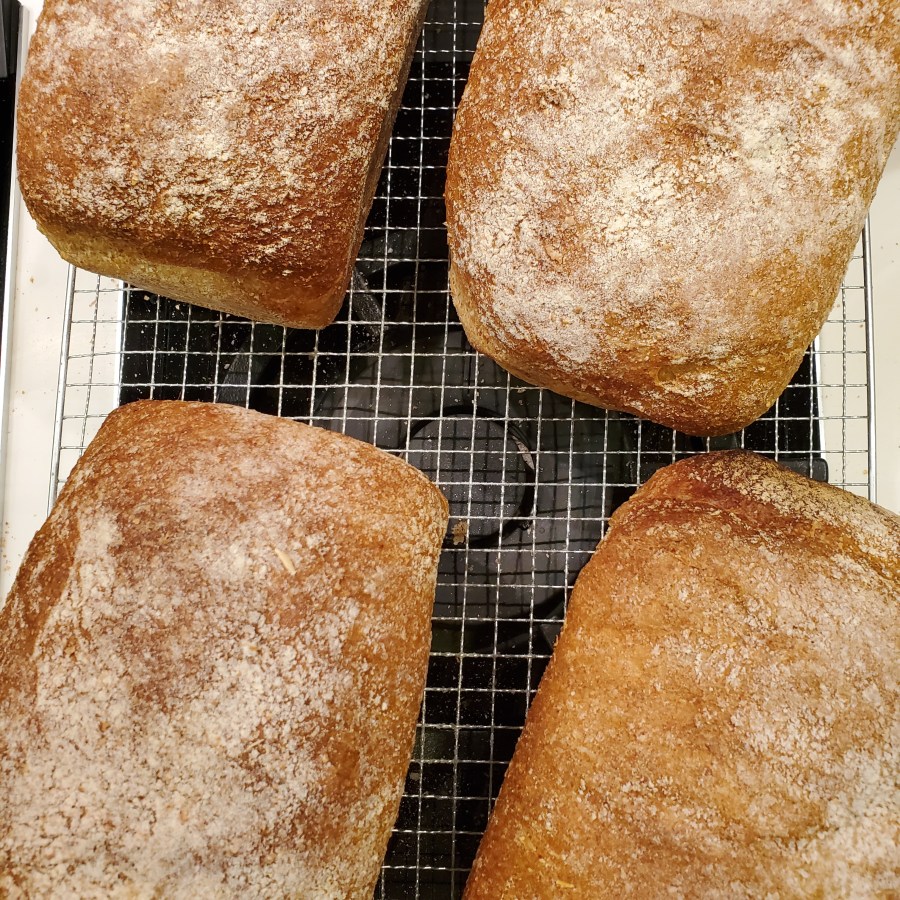
In my original attempt at this Community Bake, I modified a recipe from another blogger, Michael Wilson. His recipe was written in Baker’s Percentages, and had no method attached.
So I kind of made it up, and you can find the recipe and results in Part One.
In the original recipe, it called for Italian style starter at 45% hydration. That is THICC! I made one especially for the occasion, and it was my first.
But I wanted to see if I could get similar results with my ever-ready 100% hydration rye starter. Or perhaps using only commercial fresh yeast.
So I tried both!
But first I had to get help figure out those pesky hydration percentages. Danny came through for me, and this is what I arrived at:
| STIFF | SOFT | YEAST | |
| 25% italian style sourdough (45% hydration) 39g water + 86g flour | 125 | ||
| 100% hydration rye starter 86g water + 86g flour | 172 | ||
| Fresh Yeast Only Version (=7g instant) | 21 | ||
| 100% wholemeal flour | 500+86 in starter =586 total flour | 500+86 in starter =586 total flour | 586 |
| water | 400+39 in starter =439 total water | 353+86 in starter =439 total water | 439 |
| Effective hydration % including starter | 75% | 75% | 75% |
What looked like a simple 80% hydration loaf was quickly calculated to be 75% hydration once the starter quantities of flour and water were taken in to consideration.
The above table shows the three methods (stiff, soft, yeast). The amount of flour in the starters was subtracted from the totals. Each loaf has 586g of strong wholemeal bread flour and 439g of water. But in the stiff and soft starter loaves, some of that was used for starter. In the yeasted loaf, those numbers went straight in to the mixer and I added 21g of fresh yeast (dissolved in 50g of the water first) as an approximate amount for that quantity of flour. 21g fresh yeast is around 7g of instant. I hope.
The rest of the ingredients in all three versions of the loaf were the same, as was the method, mostly.
| 3% egg yolk | 0 | 0 | 0 |
| 10% light olive oil | 500*10%=50 | 50 | 50 |
| 5% honey | 500*5%=25 | 25 | 25 |
| 2% fresh yeast | 50*2%=10 | 10 | 0 |
| 2.4% salt | 500*2.4%=12 | 12 | 12 |
So how did that work?
Eek!
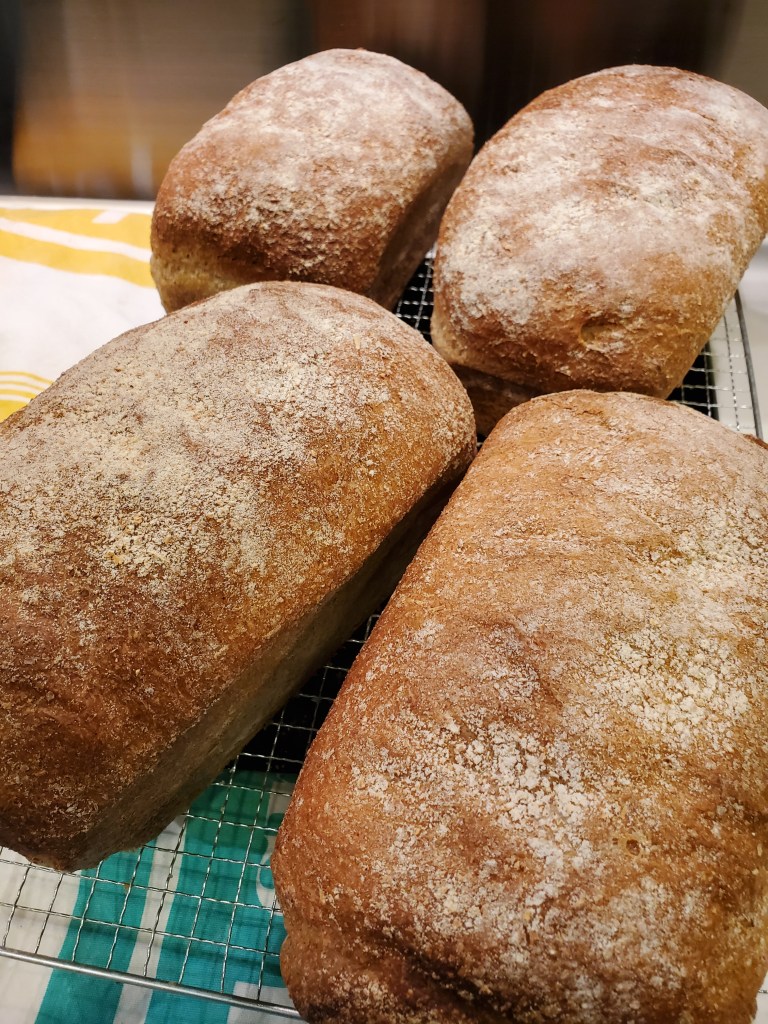
Firstly, the soft starter loaves rose fine during the bulk ferment very similar to the stiff and yeast versions. But after knock-back/preshape/rest/shape they took forever to rise in the tins.
They did eventually get there, around 3cm+ above the lip of the tins, which is when they went in to the oven. Everything else being equal, it took 90mins to get there, instead of the 30mins for the stiff starter. The yeast loaf took around 60mins.
I have no idea why that would be, but have heard internet rumours that stiff starters hold their peak activity longer than soft ones, so maybe I hit that peak? Maybe my soft starter was reaching the end of it’s most active state when I used it? Possible.
I’ve also heard that bacterial activity is different between soft and stiff starters, but I wouldn’t know if that really has an impact on rise time.
Height was comparable when they went in to the oven, and they came out nicely rounded.
But, after cooling, these loaves were not as pretty as my first attempt. The top of the loaves started to cobble, with little sunken dimples dotted across the surface. I guess this indicates larger bubbles and less strong gluten development that couldn’t hold it’s shape once baked. I don’t know why that is, all three versions got the same autolyse and mix time so I would have expected the same kind of gluten strength. Perhaps even more on the soft starter as it had so much longer to rise. In all fairness, the stiff version also dimpled overnight.
Let’s see the comparison between all three. Bear in mind the stiff starter version is from yesterday.
The arrangement of loaves is stiff, soft then yeast left to right.
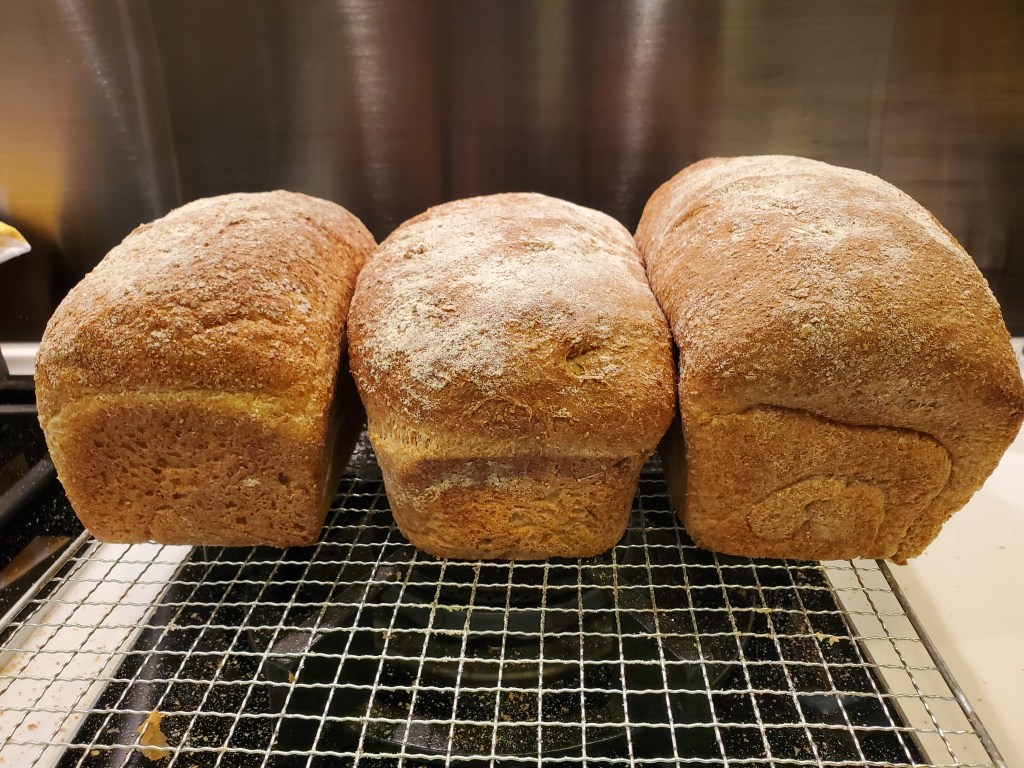
Whelp, looks like the yeast got bigger than the rest. It had 30 mins more to raise than stiff but 30 mins less than soft.
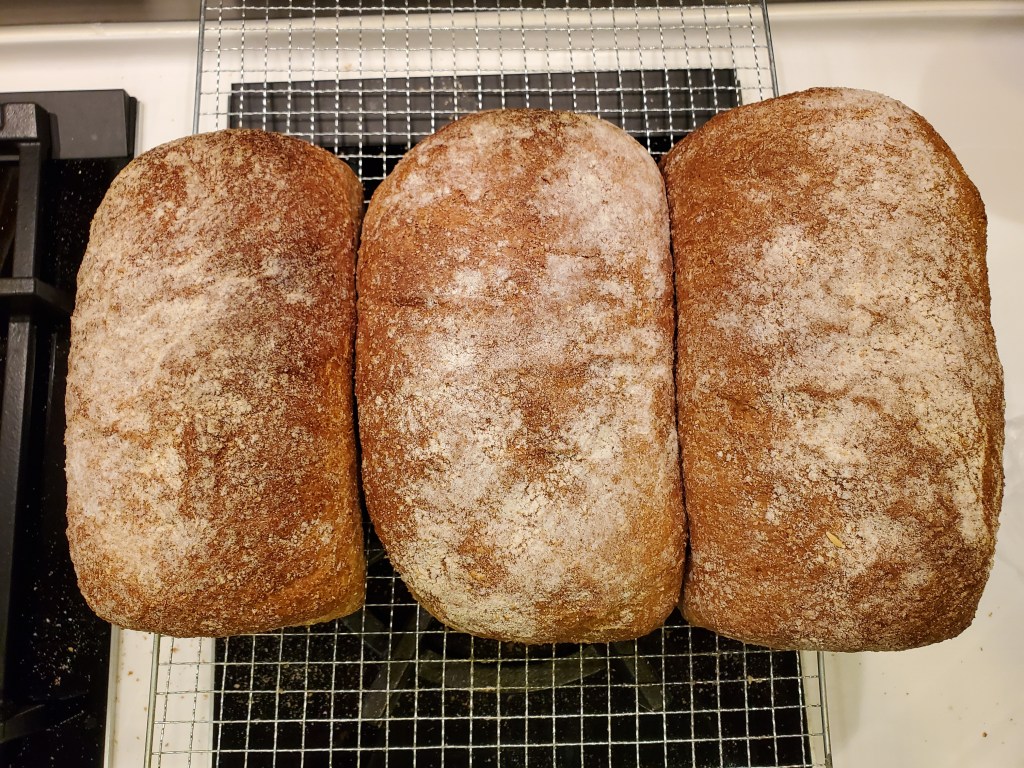
I’m also a bit cavalier when I divide my bulk ferment in to two loaves, so there isn’t any guarantee of weight accuracy here either. Don’t read too much in to the size differences.
Much better to look inside:
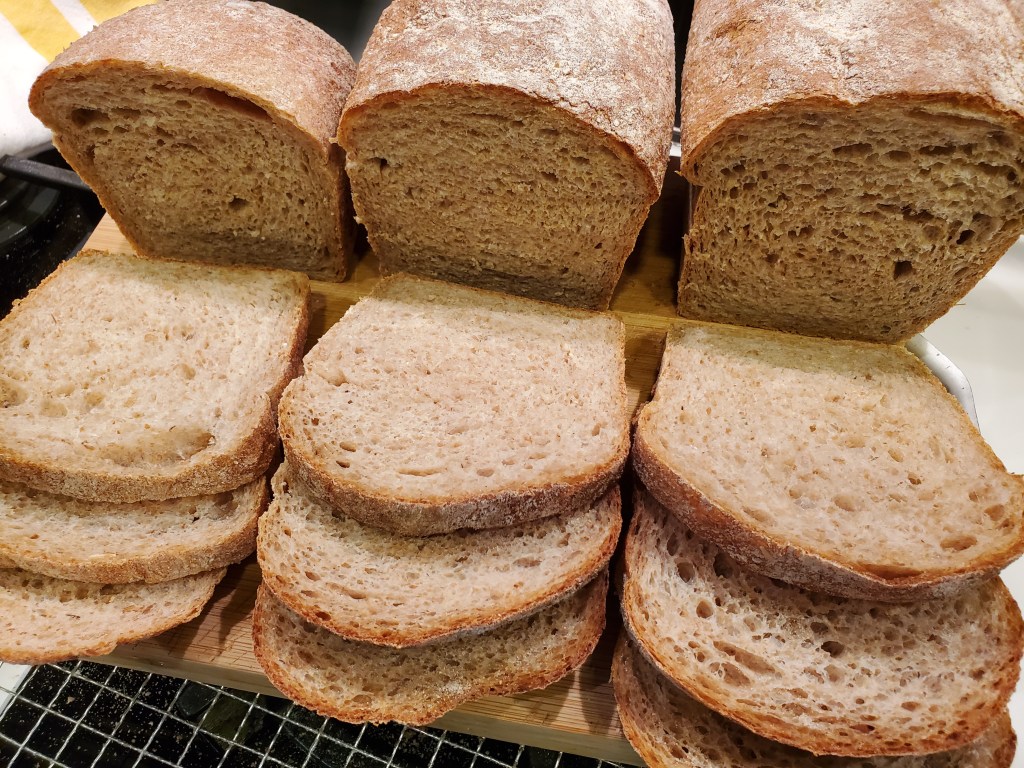
Here we can see on the far right, the holes in the yeast version are noticeably bigger than the two starter versions. I sliced in to an unfortunate pocket of air on the stiff version on the left, but that wasn’t typical of the loaf.

Just a slightly different angle. From this you’d think the centre loaf had tighter bubbles. But when you look at the slices close-up…
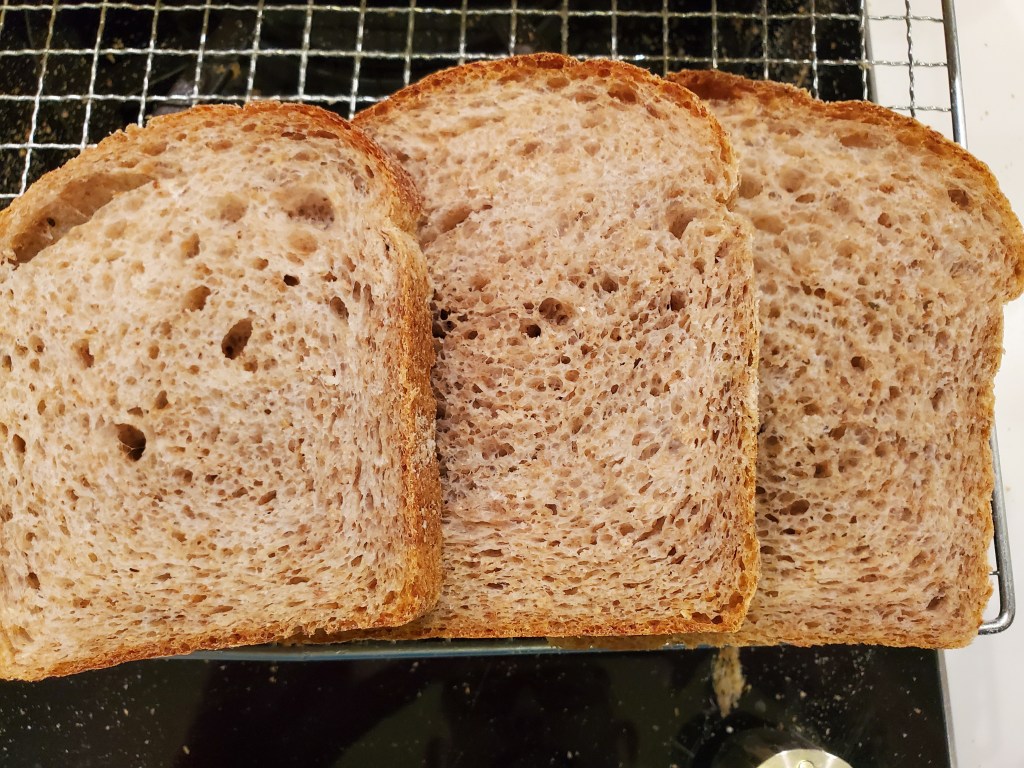
There are large sections that look identical on all slices. In fact, it’s impossible to see any difference at the bottom third of each loaf.
At this point, I think any inconsistencies are with the baker, not the ingredients. I think I need to do a better job during knocking-back, and be more consistent with rise times. For such a short second rise, the stiff starter loaf certainly holds it’s own against the other two.
Taste Test
So the most important part – what did they taste like?
Between the stiff and soft starter loaves, there was nothing in it. Both had a very slight sourdough tang that was absent in the yeast loaf (kind of obviously). Or, to put it another way, the yeast loaf tasted more of yeast than the starter loaves. Are you falling off your chair in surprise yet?
The yeast loaf was certainly fluffier and more delicate than the other two, and I feel is the ones that tastes most like a supermarket wholemeal loaf. Think Hovis Wholemeal (in the UK) and you’re in the right ballpark. If kids are going to approach any kind of wholemeal loaf, this would be it.
But for me, the two sourdough loaves have a bit more depth and complexity. That deeper, more malty note. They also feel like they have greater structural integrity than the yeasted loaf. I don’t mean dense, just stronger if that makes sense. Maybe a nice bit chewier, but still light and fluffy.
Final Thoughts

They’re all great breads. Easily sliceable, great for sandwiches, fantastic toasting potential, perfect for dipping in your boiled eggs. There are no holes big enough for the marmite to drip through, which lets face it, is what matters most.
And even better than the taste is the sense of righteousness that you’re eating wholemeal bread that tastes good!
I’m sure this kind of bread has it’s place and it is certainly approachable. Buyers of nutritionless supermarket bread will find the switch to this palatable I think. But I still prefer the heft and rigour of a nice SWBF/WW sourdough, for me it’s got more personality and makes more of a meal. And personally, I think it’s easier to bake.


 twistybakes.kitchen